




University Rankings in East Asia for 2027: Top Universities, Trends and Insights
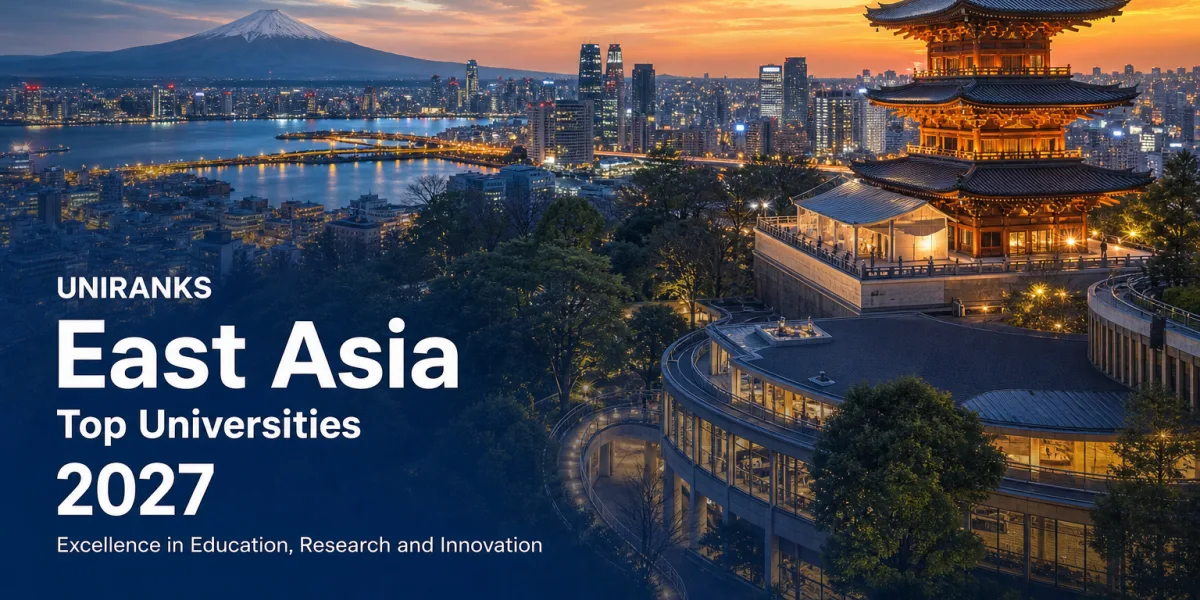
The 2027 university rankings in East Asia reflect a dynamic higher education sector characterized by intense regional competition and collaboration. This year's UNIRANKS snapshot highlights remarkable performances by universities across China, Hong Kong, South Korea, and Japan. The blend of tradition and innovation is driving institutions to boost research, enhance internationalization, and deeply engage with the evolving educational and economic landscape of East Asia.

Key Takeaways
- Tsinghua University in China leads the East Asia rankings with a total score of 95.292 and a global position of 45.
- Hong Kong universities demonstrate strong regional presence, holding three of the top four positions.
- Chinese institutions represent over half the top 10 rankings, reflecting significant higher education growth in China.
- South Korea and Japan have representation with Seoul National University and Tohoku University rounding out the top 10.
- The total scores of top universities range narrowly, indicating a competitive educational environment in East Asia.
- Collaborative regional programs and policies are supporting internationalization and research innovation among top institutions.
Introduction
East Asia continues to emerge as a pivotal region in global higher education, with its universities steadily gaining recognition for academic excellence, research, and international collaboration. The UNIRANKS 2027 rankings for East Asia showcase the leading universities that contribute to this advancing landscape. These rankings reveal a cluster of elite institutions primarily from China and Hong Kong, supported by key universities in South Korea and Japan. The region's higher education system is interconnected through initiatives fostering student mobility, joint academic programs, and multilayered cooperation across borders. As education policies evolve to meet the challenges of a rapidly changing global context, East Asia's universities also embrace digital transformation and sustainable development goals, positioning themselves as critical centers of knowledge and innovation. This article delves into the top-ranked universities, key trends influencing the sector, and in-depth analysis of the forces shaping East Asia's higher education in 2027.
Top Universities in East Asia for 2027
| Rank | University | Country | World Rank | Overall Score |
|---|---|---|---|---|
| 1 |
 China
China
|
45 | 95.3 | |
| 2 |
 Hong Kong
|
47 | 95.3 | |
| 3 |
Hong Kong
|
53 | 95.1 | |
| 4 |
Hong Kong
|
54 | 95.1 | |
| 5 |
China
|
57 | 95.0 | |
| 6 |
China
|
59 | 95.0 | |
| 7 |
China
|
67 | 94.7 | |
| 8 |
China
|
69 | 94.7 | |
| 9 |
 South Korea
|
75 | 94.6 | |
| 10 |
 Japan
Japan
|
98 | 93.9 |







Key Trends
Universities boost collaborative projects and technological advancements to enhance regional competitiveness.
Increased student exchanges and dual degrees deepen cross-border academic integration.
Institutions align curricula with market needs to improve graduate job readiness.
Adoption of digital tools enhances access, teaching, and learning experiences across campuses.
Dominance of Chinese and Hong Kong Universities in East Asia's Rankings
In the 2027 UNIRANKS East Asia university rankings, Chinese and Hong Kong institutions largely dominate the top positions. Tsinghua University in China secures the number one spot regionally, positioned at 45th globally with a total score of 95.292. Hong Kong contributes three universities occupying ranks two through four regionally, including Hong Kong Polytechnic University and the University of Hong Kong. Collectively, mainland Chinese universities occupy five places in the top 10, demonstrating sustained development and investment in the higher education sector. This concentration underscores the substantial resources, research outputs, and institutional structures focused on academic excellence in these countries. Meanwhile, South Korea and Japan feature prominently with leading universities such as Seoul National University and Tohoku University maintaining competitive standings within the top 10. The narrow total score variances among these top-ranked universities highlight the competitive nature of East Asia's higher education landscape, reflecting efforts across countries to advance quality and reputation. While rankings convey relative performance, it is essential to recognize the diverse strengths and unique attributes these institutions offer within the region's evolving academic ecosystem.
Regional Cooperation and Policy Initiatives Shaping East Asia's Higher Education
East Asia’s higher education is shaped profoundly by collaborative regional initiatives such as the CAMPUS Asia program, which facilitates student exchanges, joint curricula, and double degree programs among China, Japan, and South Korea. These efforts exemplify a strategic approach to harmonize academic standards, foster cultural exchange, and cultivate multinational professional competencies. Complementing these measures, the A3 Foresight Program promotes joint research collaborations that contribute to regional innovation and knowledge sharing. These policies reflect an intent to elevate not only individual universities but also the collective academic ecosystem across East Asia. Governments emphasize aligning educational reforms with economic strategies, integrating industry demands with academic training, and advancing internationalization to bolster graduate employability. Moreover, digital transformation initiatives are rapidly modernizing infrastructure and pedagogy, supported by frameworks such as UNESCO’s Digital Leap in East Asia report. Through these mechanisms, higher education institutions across East Asia are building interconnected networks that expand student mobility, enhance researcher collaboration, and address global challenges with a regional perspective. This convergence of policy and practice underpins the dynamic higher education environment observed in the 2027 rankings.
Emerging Trends and Challenges in East Asian Higher Education
The East Asian higher education sector is witnessing several emerging trends alongside persistent challenges as it adapts to contemporary global demands. Research and innovation growth remain central, with universities expanding collaborative projects and pushing technological frontiers, securing their roles as innovation hubs. Internationalization continues to gain momentum, evidenced by increased cross-border student mobility and the expansion of dual degree programs, reinforcing East Asia's position as an academic crossroads. Graduate employability initiatives underscore efforts to align academic offerings with labour market needs, coordinating closely with industries to deliver relevant skills. Concurrently, digital transformation reshapes educational delivery, expanding access and quality through advanced technologies. However, challenges such as sustaining equitable access amid rapid expansion, managing cultural diversity within internationalized settings, and ensuring financial resources for continuous innovation persist. Student experience and wellbeing also receive growing attention as institutions balance academic rigor with supportive environments. Sustainability and adherence to the Sustainable Development Goals (SDGs) are incorporated progressively into campus operations and curricula, reflecting a commitment to societal impact. Navigating these complex dynamics is pivotal for East Asia's universities as they maintain global competitiveness while addressing regional and global imperatives.
Methodology
The university positions, scores and country-ranking data shown in this article come directly from the UNIRANKS 2027 ranking datasets and are not recalculated or modified by the article-generation process.
Contextual research may be used to explain higher-education developments, policy, research, internationalization and student-related trends. This contextual research does not determine or alter any UNIRANKS ranking position or score.
Country rankings and university world rankings are separate UNIRANKS datasets. Country rankings assess the overall strength and international standing of national higher-education systems, while university rankings evaluate individual institutions.
Frequently Asked Questions
What criteria does UNIRANKS use for ranking universities in East Asia?
Are the East Asia university rankings influenced by government policies?
Why do Hong Kong universities appear prominently in the Top 10?
How does internationalization impact East Asian universities?
What role does research collaboration play in East Asia's higher education?
Are digital technologies important in East Asian higher education?
How do East Asian universities support graduate employability?
Is student wellbeing a priority for East Asian universities?
Does sustainability feature in East Asia's higher education sector?
How can students use the 2027 rankings for their university decisions?
Conclusion
The 2027 UNIRANKS university rankings for East Asia highlight a highly competitive and evolving higher education landscape where Chinese and Hong Kong universities hold prominent positions supported by institutions from South Korea and Japan. This ranking snapshot reflects a balance of tradition and modernity, with universities actively engaging in regional cooperation, research advancement, digital innovation, and internationalization. The trends observed indicate ongoing efforts to increase graduate employability, student wellbeing, and sustainability. As East Asia continues to respond to global and regional challenges, these universities represent critical pillars in advancing education, research, and innovation. Prospective students and stakeholders can utilize the rankings alongside broader context to navigate opportunities within this dynamic academic region.
 German
 English
 Spanish
 French
 Portuguese
 Turkish
 Russian
 Arabic
 Hindi
Hindi Chinese
 Korean
Comments (3)
Join the discussion
Comments must be relevant to this article and cannot contain links.
Unrelated comments or comments containing links will not be published.
The East Asian higher education sector is witnessing several emerging trends alongside persistent challenges as it adapts to contemporary global demands. Research and innovation growth remain central, with universities expanding collaborative projects and pushing technological frontiers, securing their roles as innovation hubs.
The 2027 UNIRANKS university rankings for East Asia highlight a highly competitive and evolving higher education landscape where Chinese and Hong Kong universities hold prominent positions supported by institutions from South Korea and Japan.
yes, the trends observed indicate ongoing efforts to increase graduate employability, student wellbeing, and sustainability.